Pallet handling · Sorting · Repair systems
Pallet Pooling Repair Systems from Paterson Hughes
Designed around your pallet, your damage profile and your building. Three lines delivered, proven at 360 to 600 pallets per hour.
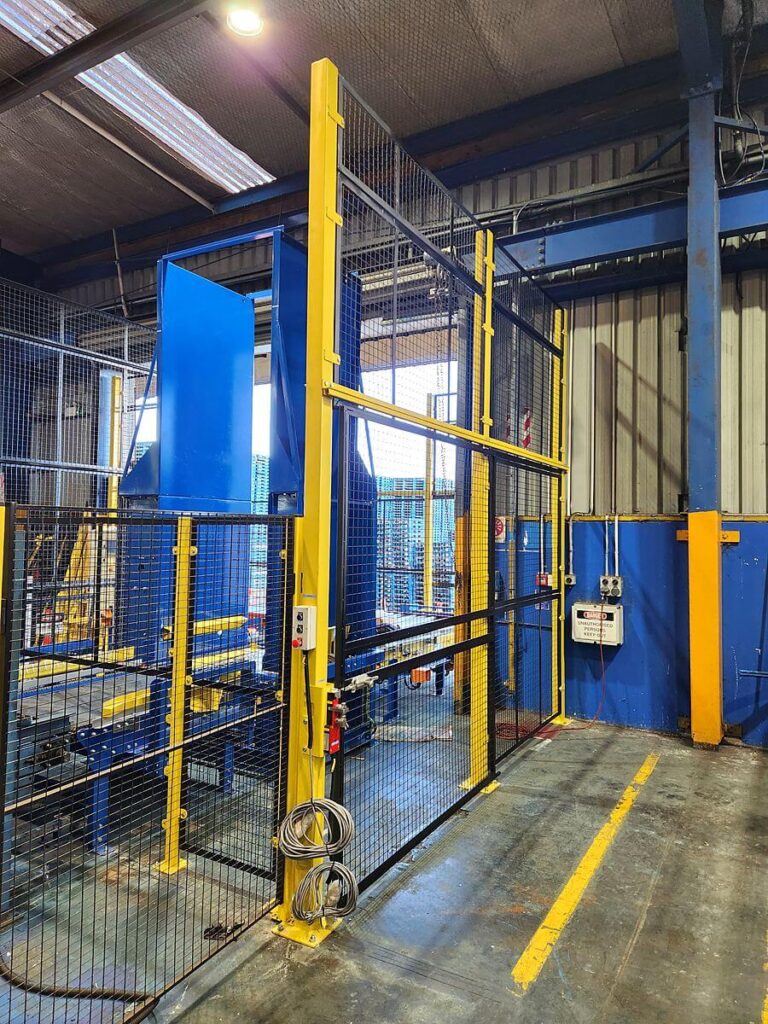
Interlocked guard door and mast enclosure with mesh guarding and lockout tongue
Proven rates
360 – 600 pallets/hr
Lines delivered
Three
Built with
Paterson Hughes, since 1946
Designed to
AS/NZS 4024
1.0
Scope
What a pallet handling line does
Pallets return in stacks and in mixed condition. They must be separated, assessed, routed, repaired, restacked and despatched continuously, without a queue forming at the infeed.
The machinery handles the lifting, moving, stacking and sorting. Your operators handle assessment and repair. Balancing the two correctly is what allows the line to run at the rate of the work rather than the rate of the handling.
2.0
Rates
Proven performance
Each line is rated on demonstrated performance at factory acceptance testing, using real pallets, with the customer welcome to attend.
360
DeStacker
pallets/hr
600
Stacker
pallets/hr
400
Production line
pallets/hr
Three separate projects — a DeStacker line, a Stacker line and a full production line, each proven at FAT.
Faster rates are achievable in service, depending on the pallet mix on the day.
3.0
Approach
Customised, not catalogue
Paterson Hughes’ equipment range reflects 20 years of projects. We select and combine from it to build a system for your requirements, because no two operations are alike.
- The pallet. Timber or plastic, size, pooled standard or proprietary.
- The damage profile. The proportion arriving good, repairable and scrap determines the number and placement of repair positions.
- Volume and peaks. Steady throughput and seasonal surge require different configurations.
- The building. Clear height, column spacing, floor condition and truck access constrain the layout.
- The labour model. Operator numbers, shift patterns and which tasks remain manual.
4.0
Equipment
What we design into a line
- Conveying — chain and roller conveyor sized for loaded pallets, not cartons.
- Stacking and destacking — the front and back end of almost every line.
- Lifts and transfers — moving pallets between levels and across the flow to keep the layout inside your building.
- Sorting and diverting — getting each pallet to the right destination without an operator walking it there.
- Repair positions — presented at working height, in the order the work actually happens.
- Load-out — dock conveyors and despatch, so finished stacks leave without a forklift bottleneck.
- Controls — cabinet, PLC and operator interface, with fault reporting your maintenance team can read.
5.0
Safety
Safety system designed to AS/NZS 4024
All systems are engineered to AS/NZS 4024, the machinery safety standard applied on New Zealand sites.
Compliance is built into the layout from concept stage rather than added at tender. This affects access points, isolation and maintenance routines, and produces guarding that fits the machine properly rather than being retrofitted around it.
- Fixed perimeter guarding, with access only where it is needed
- Interlocked and lockable access doors
- Isolation points your maintenance team can lock off
- Emergency stops within reach of the operator positions
- Status indication so people can see the machine’s state before they approach it
6.0
Sizing
Information required for a design
With most of the following we can provide a layout and a budget figure.
Pallet
Type, size, timber or plastic, pooled standard or your own, weight empty and loaded.
Condition mix
Roughly what proportion arrives good, repairable and scrap.
Volume
Pallets per hour at peak, hours per shift, shifts per day, and seasonal variation.
Repairs
What work is done by hand, how many operators, and how long a typical repair takes.
Building
Clear height, floor area, column spacing, floor condition, truck access.
Flow
Where pallets come in, where they go out, and what happens either side of the line today.
Services
Power available, compressed air, dust and waste timber handling.
Timing
When it has to run, and what shutdown window you have to install it in.
7.0
Supply
How we sell it
One lump sum in NZD covering concept and solution design, the equipment, freight and customs clearance, mechanical and electrical installation, commissioning, operator and maintenance training, documentation and a 12-month warranty.
Building work, foundations, power to the machine and compressed air are yours — and you get the full exclusions list in writing before you sign, not after.
8.0
Partner
Built with Paterson Hughes
PATERSON·HUGHES
South African materials handling specialists, in the trade since 1946. Nash NZ designs, supplies and supports their pallet handling and repair systems in New Zealand.